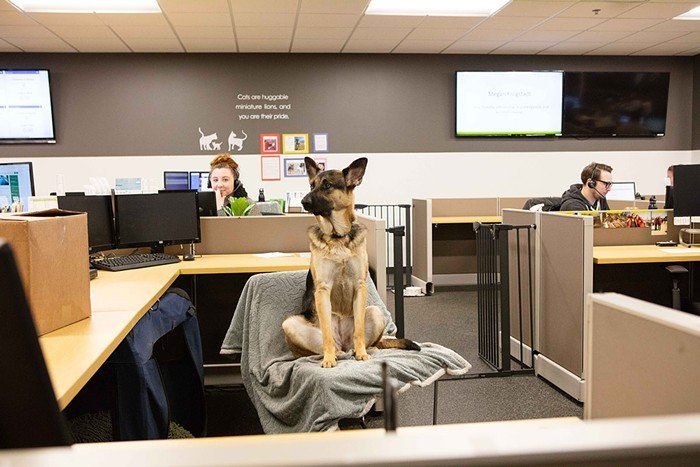
Many employers are allowing dogs in the office and it appears to be working out well.
While we hear that remote working is becoming more common and accepted by most employers, this may change. Experts in commercial real estate are now suggesting that permanent remote working will slowly be phased out. What will replace it is intermittent remote working.
Staffers may be able to work from home two or three days per week. For the rest of the week, they will be expected in the office.
And when they come back, some of them may be bringing their dogs. We are not talking about service animals, used by people who, for instance, have limited vision. We are talking about ESAs – emotional support animals.
The pandemic has been so difficult for so many people that their dogs have become much more important in their lives. Returning to the office is fine: but they want to bring their dogs with them.
An ESA, is a written document, usually prepared by a doctor, indicating that the owner needs the dog for emotional support.
If a tenant wants to move into a “no-dog” apartment building, the landlord, in most cases, will be required to allow the tenant and their dog to move in. It’s federal law.
This is not the case for business owners or facility managers.
At this time, employers and facility managers have no legal duty to accommodate pets at work or in their facilities, unless, as referenced earlier, they are a service animal.
However, many employers are allowing it, whether the employee has an ESA or not. What’s more, most are happy they do allow dogs in the office.
Among employers doing so are the following:
Amazon.
About 4,000 dogs are “registered” (we will talk about this later) to come to work with their owners every day.
About 4,000 dogs are “registered” (we will talk about this later) to come to work with their owners every day.
Ben & Jerrys.
“K9-5ers,” as they are called, are found in this company’s Vermont headquarters regularly.
“K9-5ers,” as they are called, are found in this company’s Vermont headquarters regularly.
Eventbrite. This event-planning organization has allowed “barklings” in the office since 2006. They have about 35 registered dogs in the office on most days.
Glassdoor. This company, which allows employees to review their current and prior workplaces anonymously, usually has about 30 dogs in the office on any given workday.
Google.
While Google does not report how many dogs are in their Mountain View, CA headquarters, they have one of the most liberal Dog Rules policies of any employer. Dogs are issued a picture ID that attaches to their collars. If the dog has this ID, it can roam the entire campus, and all its buildings, on its own.
While Google does not report how many dogs are in their Mountain View, CA headquarters, they have one of the most liberal Dog Rules policies of any employer. Dogs are issued a picture ID that attaches to their collars. If the dog has this ID, it can roam the entire campus, and all its buildings, on its own.
These employers are happy with their dog programs. Some say it has even helped them with employee retention. According to a Google spokesperson, dogs “add a playful and dynamic atmosphere to our campus.”
However, we mentioned earlier that Amazon requires all dogs to be “registered.” All these employers do. Plus, they all have rules and regulations that must be adhered to. Among them are the following:
•Employees must get the OK of all immediate teammates in the office.
•A good-behavior “dog” interview may be required.
•If submitting an ESA, it may need to be updated annually.
•Paperwork providing proof of vaccinations is required.
•Dogs are not allowed in kitchen areas or conference rooms.
•Most companies have a “Canine Code of Conduct,” requiring dogs to be quiet and not play with squeaky toys.
•Any “accidents” must be addressed immediately. Employees must notify the cleaning staff about the accident should further cleaning and disinfecting be required.
•In some cases, dogs can only be brought to the office on certain days and so many times per week.
Finally, some employers require employees to take the “Four Paws Pledge.” They promise to be Responsible, Transparent, Pragmatic, and Compliant to all regulations while their dogs are in the office.
We are infection control experts, here to help building managers keep their facilities cleaner, healthier, greener, and safer, in the most cost-effective ways possible. To learn more about Secure Clean, contact us at 888-609-1410.