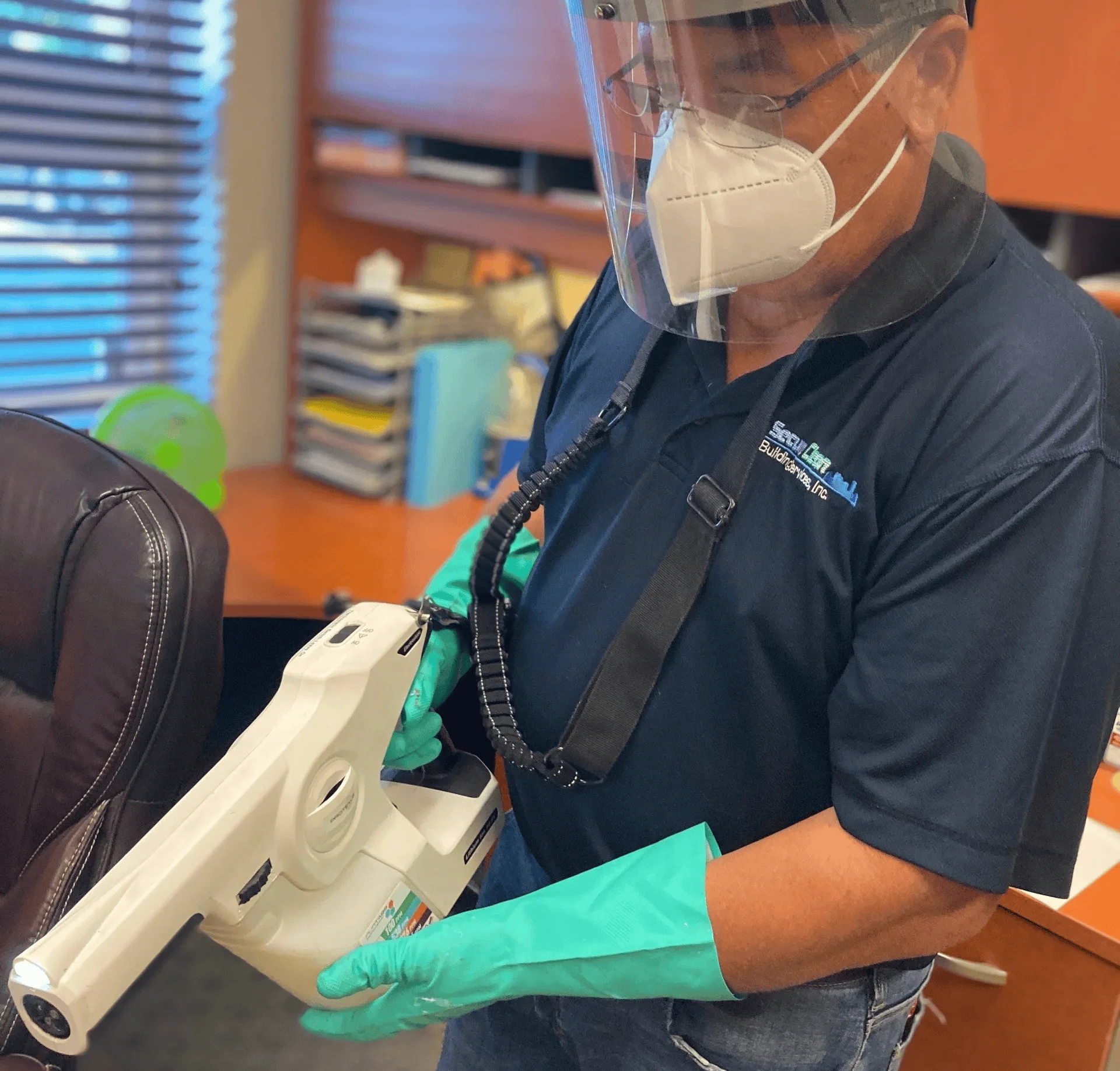
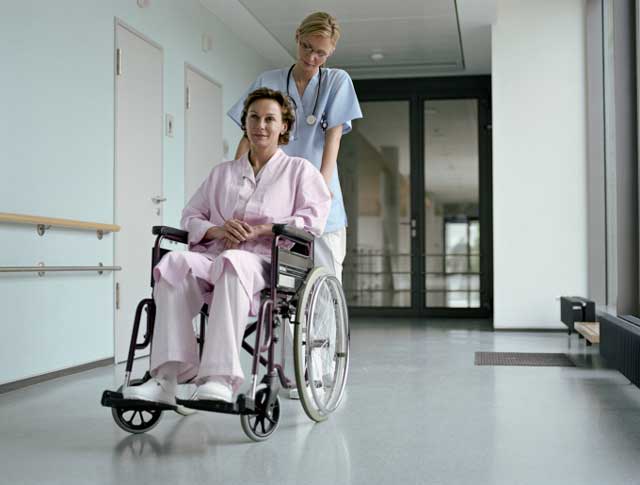
Electrostatic Sprayers were used to disinfect wheelchairs to prove their effectiveness.
Secure Clean has been using electrostatic sprayers as part of our infection control program for four years. Before using these systems, most of our cleaning and disinfecting had been performed manually. Our custodial workers would clean a surface first—by hand with sprayers and cleaning cloths—and then disinfect, again by hand.
This is a slow process, but it is the way cleaning and disinfecting are supposed to be performed. Cleaning removes soils so that the disinfectant can more effectively eliminate pathogens. One drawback to this process, on top of being slow, is that we often cannot clean and disinfect all surfaces. For example, some may be very hard to reach.
The use of electrostatic sprayers has helped us eliminate this manual process. Now we can quickly spray or mist entire surface areas, such as walls, light switches, desks, floors, chairs, tabletops, office electronics, and many more high-touch areas.
Further, because the mist is given a positive charge as it is released through the machine’s nozzle, it adheres and wraps around the negatively charged surfaces to be disinfected. That includes all those surfaces just mentioned and more.
So, we know it’s fast. We know the mist can cover more surfaces than manual cleaning and disinfecting. Now the question is, is this process effective at killing pathogens, such as the coronavirus that causes COVID?
Fortunately, a study published in the August 2020 issue of American Journal of Infection Control
says it is.
says it is.
This study was conducted in a Cleveland Veterans Affairs Medical Center
to investigate whether electrostatic sprayers are effective at cleaning and disinfecting shared wheelchairs. In a hospital setting, wheelchairs may be used by many people during the day, and many surfaces on the wheelchair are touched and can become contaminated.
to investigate whether electrostatic sprayers are effective at cleaning and disinfecting shared wheelchairs. In a hospital setting, wheelchairs may be used by many people during the day, and many surfaces on the wheelchair are touched and can become contaminated.
In the past, hospital wheelchairs were cleaned by hand using wipes. Once again, a slow process. Further, how well the chairs were cleaned and disinfected varied depending on who was performing the task and how quickly the next patient needed the chair.
To find out if electrostatic technology could eliminate this process, researchers used electrostatic sprayers filled with a disinfectant per the manufacturer’s instructions. Visibly soiled areas were first cleaned using a hydrogen peroxide wipe. As discussed earlier, cleaning should always be performed before disinfecting.
With this completed, the electrostatic sprayer was used to mist several surfaces on the wheelchairs, including the armrests, seat, backrest, and hand grips for pushing the wheelchairs, which were then allowed to air dry. Drying time took from two to five minutes.
Cultures were taken before misting, to see how many pathogens were on those surfaces, and then again after misting, to see if any remained. Here is what the researchers reported:
•There was a significant reduction in contamination for each site after the application of the spray disinfectant.
•The entire procedure took about five minutes to mist 15–20 chairs in a waiting room, four times faster than if the wheelchairs had been disinfected manually.
•More specifically, the amount of time required to apply the spray disinfectant to one wheelchair was 20 seconds, whereas manual disinfection required 84 seconds.
•There was minimal to no visible residue [found on the wheelchairs] after spraying.
•Eight [hospital] environmental services personnel trialed the device, and all expressed positive opinions regarding its use for devices such as wheelchairs and waiting areas.
•The electrostatic sprayer can be used with a variety of different disinfectants and sanitizers.
Results like these confirm why we believe this technology is essential and why Secure Clean is putting it to use. Our goal is to keep our clients’ facilities as healthy as possible, and electrostatic sprayers help us accomplish this.
We are infection control experts, here to help building managers keep their facilities cleaner, healthier, greener, and safer, in the most cost-effective ways possible. To learn more about Secure Clean, contact us at 888-609-1410.
Source: Jennifer L. Cadnum, Annette L. Jencson, and Scott H. Livingston, et al., “Evaluation of an electrostatic spray disinfectant technology for rapid decontamination of portable equipment and large open areas in the era of SARS-CoV-2,” American Journal of Infection Control, August 2020.